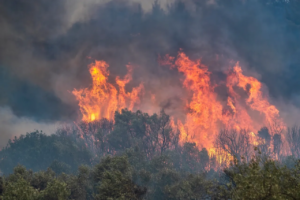
Australia is one of the most bushfire-prone regions globally, with its hot, dry climate and expansive natural landscapes frequently igniting devastating fires. These fires pose significant threats to lives, properties, and infrastructure, particularly in regions marked as bushfire-prone. In response, the National Construction Code (NCC) plays a critical role in mitigating these risks through well-defined standards like Specification 43, designed specifically for Class 9 buildings—hospitals, schools, and care facilities that house vulnerable populations.
These buildings are often difficult to evacuate quickly, increasing the need for stringent safety measures. Spec 43 establishes fire protection measures that mitigate bushfire impact, ensuring these structures are resilient enough to withstand ember attacks and radiant heat. The proactive use of fire-resistant materials, building separations, and safe landscaping surrounding these facilities is a key mitigation measure, reducing the chance of fires spreading or causing significant harm.
Given that bushfire risks are not uniform across Australia, Specification 43 applies nationwide, offering a standardised approach to ensure vulnerable facilities are safeguarded, particularly in high-risk bushfire zones. Adherence to these guidelines is crucial for both consultants and designers to help communities reduce the damage caused by bushfires, protect lives, and maintain critical infrastructure.
Next, we’ll explore the finer details of Spec 43, including material choices, the 1.5-metre perimeter pathway, and how to apply it in practical terms.
Separation Requirements: C2, C3, C4, and C5 in Specification 43
One of the essential elements of Specification 43 is the requirement for adequate separation between buildings to reduce the risk of fire spread. Sections C2 through C5 outline various aspects of these separation measures:
- C2: Requires minimum separation between Class 9 buildings and classified vegetation so that the maximum radiant heat flux a structure can be exposed to is 10kW/m2.
- C3: Deals with external walls and the importance of non-combustible cladding in areas with high bushfire risk as well as the separation between buildings.
- C4: Focuses on specific site layouts and the building siting requirements with separation from the allotment boundary or open carparking areas.
- C5: Deals with the storage of potential hazards, such as fuel storage, and separation of buildings to storage or hazardous material.
These separations act as firebreaks, minimising the risk of one building igniting another. Depending on the building type, location, and bushfire attack level (BAL), these separations must be carefully calculated and designed into the project.
Each of these provisions works together to ensure that a Class 9 building, once constructed, maintains both structural integrity and fire safety in the event of a bushfire, thereby protecting occupants. Now, let’s dive deeper into some of the practical aspects, such as the 1.5-metre perimeter pathway.
C6: Non-Combustible Pathway – Clarification Needed
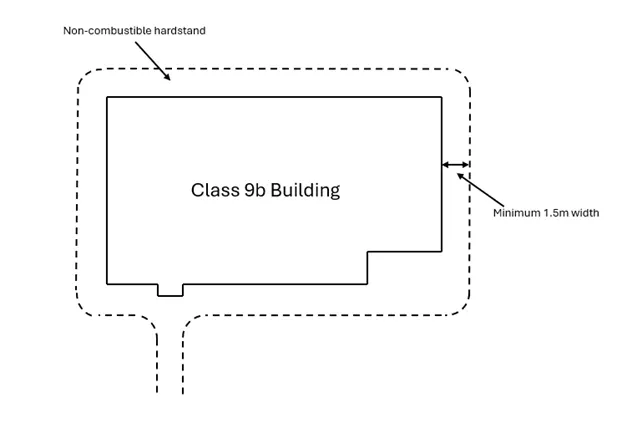
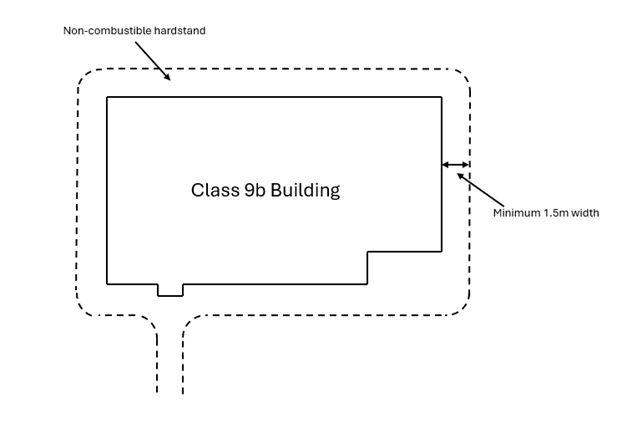
C6 in Specification 43 refers to the requirement for a non-combustible pathway surrounding Class 9 buildings. This pathway acts as a buffer zone, reducing the chance of fire spreading to the building. However, there is some ambiguity that the NCC needs to address:
- Proximity to the building: It’s unclear if the pathway must be immediately adjacent to the building or can be set back (e.g., 5 metres away).
- Existing adjacent structures: If a new building is constructed adjacent to an existing structure, does the pathway still need to be continuous around the entire perimeter, or would this require a performance solution to comply?
These uncertainties highlight the need for further interpretation or consultation with local authorities to ensure full compliance with the specification.
In practice, bushfire consultants may need to propose performance solutions in cases where pathways are interrupted by existing buildings or infrastructure, ensuring that the non-combustible barrier still serves its intended purpose of mitigating fire risks. Clarification from building certifiers or amendments in future editions of the NCC could help standardise this requirement, ensuring more straightforward application in complex projects.
Sections C7 to C14 of Specification 43 detail essential fire protection measures for Class 9 buildings. Pathways must be clear, even, and at least be 1-metre wide (C7), while external areas, where occupants might shelter from bushfire, must not be exposed to more than 1kW/m2 (C8). Internal air systems must maintain tenability (C9), and building envelopes must comply with AS3959 – BAL 19 standards (C10). Water and emergency power must be available for firefighting and operational support for at least 6 hours (C11–C12), signage must warn against combustible material storage (C13), and vehicular access must meet large isolated building standards (C14). Together, these provisions help ensure that critical building elements remain resilient in bushfire-prone environments and firefighting personal can operate effectively.
Conclusion
Specification 43 of the NCC plays a vital role in enhancing the safety and bushfire resilience of Class 9 buildings, which house vulnerable occupants like the elderly, sick, and young. By following the stringent separation guidelines, using non-combustible materials, and adhering to fire protection measures, bushfire consultants can significantly mitigate the risks associated with fires.
However, areas of ambiguity—such as the non-combustible pathway’s proximity to buildings—require clarification or performance solutions. Through careful planning and expert guidance, consultants can ensure that their designs meet these requirements and contribute to protecting lives and infrastructure. Compliance with Spec 43 not only safeguards communities but also helps maintain critical infrastructure that’s essential during emergencies. By following these detailed specifications, the community will be better prepared to withstand future bushfire threats.
For more information on Spec43 feel free to contact us .